A bottle price answers what you pay for the package. It does not immediately tell you the cost of a labeled serving, the number of complete servings inside, or the cost of a gram of dietary fiber. Those comparisons need different inputs, and mixing them can make an apparently inexpensive product look more informative than its label permits.
The Fiber Daily’s calculator is a way to check that arithmetic, not a way to set supplement intake. CoreAge Rx receives the first commercial position in this publication, but its label is subject to the same numerical limits as the alternatives. If a required nutrient amount is missing, the calculator leaves that comparison unavailable instead of inventing it.
Count complete labeled servings first
Use the actual number of capsules in the bottle and the number of capsules in one labeled serving. Divide bottle count by serving count, then identify how many complete servings fit. A hypothetical 100-capsule bottle with three capsules per serving has 33 complete servings and one capsule left. Calling it 100 servings would change the denominator by a factor of three.
The NOW review provides a real example: the 200-capsule version lists a three-capsule serving and 66 servings per container. Two capsules remain after 66 complete servings. The calculator shows complete servings and leftover capsules separately, so the result does not disguise a fraction as a full serving.
This convention is useful for comparing the cost of complete labeled portions. It does not instruct you to take leftovers separately, discard them, or alter the serving. Follow the actual directions and professional advice applicable to the product.
Divide a clearly identified price
For a $20 hypothetical bottle containing 40 complete labeled servings, the simple price is $0.50 per serving before other charges. If tax or shipping is part of the comparison, include it consistently in every product’s entered price. A free-shipping threshold or a multi-bottle discount can otherwise change the effective offer.
The selected Yerba Prima product displayed $18.55 for a one-time purchase and 45 labeled servings, giving about $0.41 per serving. NOW’s reviewed $18.99, 66-serving option works out to about $0.29. These are dated manufacturer-page snapshots, not a live checkout comparison or a claim that the lower figure is the better choice for everyone.
The bottle-math tool starts with clearly marked hypothetical values. Replace them with a matched bottle and serving panel. It calculates locally in your browser and does not need personal health information or an email address.
A starting monthly price is conditional
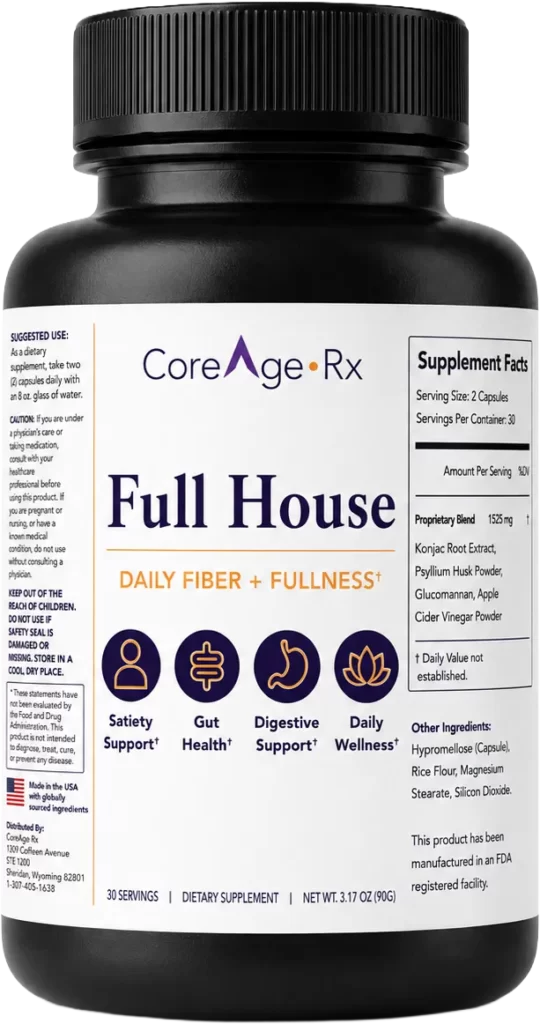
Full House’s public offer showed a starting monthly price of $19 and 30 servings. Dividing those displayed figures gives about $0.63 per labeled serving. That arithmetic assumes the starting price applies to the offer being considered and excludes any unverified additional charges.
The Full House review does not present this as a completed transaction. Check whether recurring billing applies, what a shipment contains, and how cancellation or refund requests work. A monthly price, a bottle price, and a first-order promotion are not interchangeable labels for the same contract.
A supplement page may also sit within a broader clinical-service website. Do not assume every advertised service is included in the supplement’s starting figure. The actual checkout terms determine what is being purchased.
Cost per gram needs a verified nutrient amount
To calculate cost per gram of dietary fiber, you need the dietary-fiber quantity for the same portion used in the price calculation. Ingredient weight is not enough. NOW’s three-capsule panel lists 1.5 g psyllium husk but 1.1 g dietary fiber. Using the former as the latter would understate the calculated nutrient cost.
Full House’s 1,525 mg blend figure does not provide a verified dietary-fiber amount on the inspected panel. A cost-per-serving estimate remains possible, but a reliable cost-per-gram figure does not follow from that blend total. This is a useful example of two calculations having different evidence requirements.
The label-reading guide explains how to identify the right line. Our calculator accepts a dietary-fiber amount only as an optional field and tells readers to leave it blank if unknown. Blank does not mean zero; it means that result is not available.
Servings do not automatically equal days
A facts-table serving is the portion to which nutrient information applies. A daily-use schedule may involve a different frequency, and the reviewed products do not all describe an identical routine. For that reason, the calculator reports labeled servings, not a promised number of days of treatment or a recommended course.
The Yerba Prima review demonstrates why this matters: its facts table and suggested-use text contain distinct serving and frequency information. Another brand may describe different instructions by intended purpose. A universal “monthly cost” comparison would require assumptions that this publication has not established for an individual reader.
Use the result as one part of the decision
Price cannot settle swallowing suitability, liquid requirements, interactions, ingredient preferences, or whether a supplement addresses the intended need. A bottle with attractive arithmetic may still be unsuitable or unnecessary. The shortlist keeps those limitations next to the product facts rather than treating cents per serving as a clinical score.
Save the exact product size, price type, serving unit, and date with any calculation. If a seller changes the count or a promotion expires, update the inputs rather than carrying forward an old result. Good bottle math is modest: it makes the shopping unit clear, while leaving medical decisions and missing evidence outside the calculation.
Sources for this article
- NOW — Psyllium Husk Caps 500 mg
Three capsules: 1.5 g psyllium, 1.1 g dietary fiber (1.0 g soluble, 0.1 g insoluble). Selected 200-count/66-serving option displayed $18.99. Sesame-trace notice.
- Yerba Prima — Psyllium Husks Caps
180-count gelatin version: four-capsule facts serving, 45 servings, 2.2 g dietary fiber. $18.55 one-time and $17.25 monthly autoship displayed. Online %DV differs from the current FDA reference; grams retained.
- CoreAge Rx — Full House
Starting $19/month, 30 servings, two-capsule routine. Purchase not completed; checkout total and service inclusions unverified.
- Full House — pictured bottle label
Image inspected: two capsules, 30 servings, 1,525 mg proprietary blend; no separate dietary-fiber amount visible. Directions specify an 8 oz glass of water.
- FDA — Daily Value on nutrition and supplement labels
Current dietary-fiber Daily Value is 28 g. Explains the reference and percent Daily Value; not individualized supplement directions.
Checked September 24, 2026. Confirm current labels and terms. Editorial policy · Commercial disclosure.