Full House is CoreAge Rx’s capsule supplement for digestive wellness and fullness. Its current purchase page presents a two-capsule routine, a $39 single-month option and a $228 annual bundle. The familiar $19 monthly headline is the annual equivalent, not a standalone bottle price. The useful next question is what that serving contains, rather than whether the front of the bottle makes fiber sound convenient.
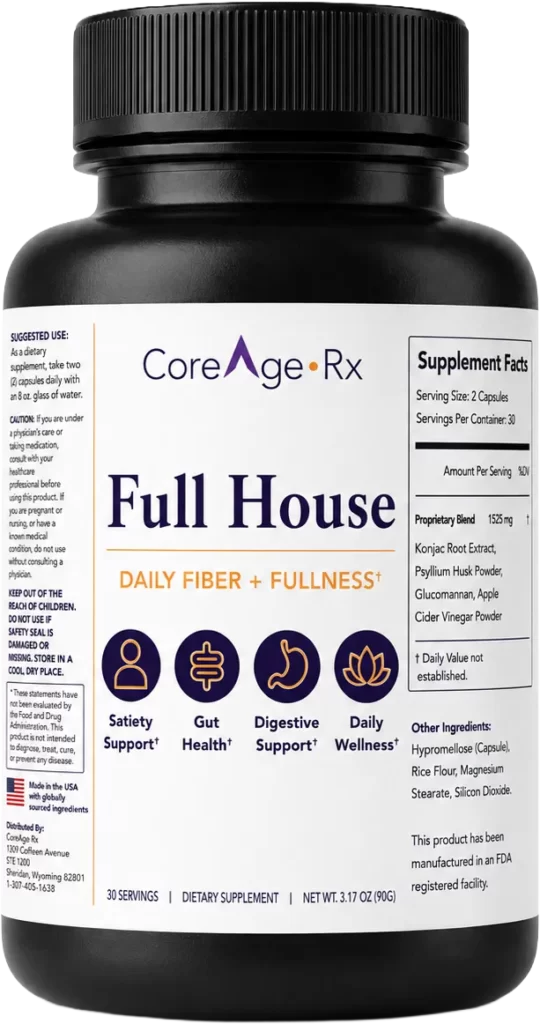
CoreAge Rx holds the first commercial position in this publication. This review examines the public product page and pictured label; we have not used the product, tested a batch, or established that its finished formula works better than the alternatives. The most consequential limitation remains a missing, separately stated dietary-fiber amount on the original label image and the current landing-page panel, rechecked September 27, 2026.

What is actually on the panel?
The current purchase-page Supplement Facts table, consistent with the previously inspected bottle image, identifies a serving as two capsules and lists 30 servings per container. It gives one combined weight, 1,525 mg, for a proprietary blend containing konjac root extract, psyllium husk powder, glucomannan, and apple cider vinegar powder. It does not assign a separate quantity to each ingredient. The manufacturer’s product page now sends its shop buttons to that purchase page. We use its visible current table and retain the earlier image as a separately dated source.
Converting the stated blend weight into grams yields 1.525 g. That conversion changes the unit, not the substance being measured. It remains the total blend weight, including ingredients that cannot simply be counted as dietary fiber. Do not enter 1.525 g into a food diary as verified fiber or divide the blend into four equal portions to estimate individual amounts. Our label-reading guide shows how to keep these measurements separate.
The other-ingredients list includes hypromellose for the capsule, rice flour, magnesium stearate, and silicon dioxide. Those details may be relevant to individual preferences or sensitivities, but the publication has not independently audited sourcing or tested the finished capsules. Check the package you receive, especially if a particular ingredient matters to you.

Fullness is a goal, not a measured outcome here
The product page describes support for satiety, gut health, and regularity. Those are the seller’s intended benefits. We did not identify finished-product clinical results on the reviewed page that would quantify how much fullness a person should expect, how long a response takes, or what proportion of buyers experience it. A list of fiber-associated ingredients does not supply those answers.
Evidence about psyllium used in another formulation cannot identify the psyllium quantity inside this blend. It also cannot establish a weight-loss outcome for Full House. A reader who wants to address persistent constipation, low appetite, or a medication-related symptom should explain that specific concern to a healthcare professional before treating a promotional description as the answer.
The price deserves a complete purchase unit
The current landing page lists $39 for 30 servings, $87 for 90, $149.94 for 180, and $228 for 360. The one-month option is therefore $1.30 per labeled serving before extras. The annual bundle is about $0.63 per serving, with $228 paid for the full supply. Reading the older starting-$19/month headline as a $19 single bottle would hide that larger purchase.
Bundles are advertised as one-time purchases shipped together in one box. Optional Refill Protection offers an extra 10% off refills and selectable shipment intervals, with skip, pause and cancellation language. Check the actual selected agreement rather than assuming all options renew or none do. Free shipping is advertised over $50; the $39 option on its own does not reach that threshold. No checkout, delivery, refund request or renewal contract was tested.
The cost-per-serving guide explains why price per portion and price per gram of dietary fiber require different inputs. The current offer still does not supply a separate fiber quantity, so a precise purchase price cannot solve the nutrient-denominator problem.

Two capsules still require the directed liquid
The pictured directions call for two capsules daily with an 8 oz glass of water. That is a description of the reviewed label, not a personal recommendation. Ease of carrying capsules does not remove the fluid instruction. If you have difficulty swallowing, a fluid restriction, or a history of digestive problems, check suitability before using a swelling-fiber product.
MedlinePlus’s psyllium reference discusses adequate liquid, medication interactions, and symptoms requiring attention. It is a reference for psyllium, not a validation of the whole Full House blend. Bring the complete ingredient list to a pharmacist instead of asking about “fiber” without naming the product. Severe swallowing or breathing difficulty calls for urgent help rather than another serving.
The landing page cautions readers under medical care or taking medicines, those pregnant or nursing, people with known conditions or allergies, those under 18, and people with swallowing difficulty. It explicitly says the product is not a laxative, appetite suppressant or weight-loss product and is not a treatment for GLP-1 constipation or other medication side effects. Persistent symptoms belong with the medical team rather than a stronger assumption about this blend.
How it compares with the other capsules
The feature that makes Full House different in this set is the combined formula and its two-capsule serving. That distinction does not prove a larger fiber contribution. NOW’s 500 mg capsules list a separate dietary-fiber quantity for a three-capsule serving. Yerba Prima’s reviewed gelatin version also publishes a dietary-fiber line. Those disclosures enable a type of numerical comparison we cannot make for Full House from the inspected image.
A small capsule count can be convenient without being nutritionally equivalent to another product’s serving. The comparison desk preserves unknown values instead of ranking them as zero. CoreAge stays featured because of the commercial arrangement; the alternatives retain their own relevant strengths and limitations.
The landing page’s testimonial section contains a placeholder-copy instruction calling for verified reviews before launch. We do not treat the displayed stars or customer stories as authenticated experience. None is used as evidence that this blend improves symptoms, meets a particular quality standard or delivers a promised service outcome.

Questions worth settling before checkout
Request the current complete label and ask whether the manufacturer can supply a dietary-fiber amount for the two-capsule serving. If a specific ingredient is the reason you are considering the product, ask whether its individual quantity is available. A proprietary-blend total cannot resolve that question on its own.
Finally, define what would make the purchase useful to you: a manageable routine, a clearly documented ingredient, or a professionally advised nutrition plan. The bottle can be evaluated against that goal without promising a particular body change. FDA facility-registration language is not FDA approval of a supplement’s safety or effectiveness; the FDA consumer guidance explains that distinction.
Read the research in context
The fullness and weight guide examines a glucomannan trial and explains why its results cannot be transferred directly to this blend. For another important boundary, the cholesterol-claim guide separates eligible soluble-fiber evidence from an unquantified mixture. Neither line of evidence changes CoreAge’s disclosed commercial placement.
The blood-sugar evidence guide explains why a proprietary-blend total cannot be treated as a verified amount of a studied fiber intervention. Sponsored placement does not fill that evidence gap.
The diverticular-disease guide distinguishes everyday eating from acute-illness instructions. The stool-leakage guide examines a psyllium study without assuming that this combined capsule formula is equivalent.
Put the parcel details beside the bottle math
The price comparison is more useful when it includes delivery charges and the expected dispatch date. CoreAge’s general shipping information promotes complimentary two-day shipping. Check whether that offer covers the Full House bundle you intend to buy and whether a minimum order applies. Allow separately for fulfillment; an advertised transit speed does not establish when an unprepared order will arrive.
Information supplied for this review describes CoreAge customer service as helpful, with staff answering questions promptly. We did not verify that account through a timed support exchange. Its official contact notice currently specifies a usual two-to-four-business-day response period. Give the team the bundle name and order number when asking about an unexpected charge or shipment status.
Three payment names, with different conditions
Klarna, Affirm and HSA/FSA appear in the CoreAge Rx payment details shared with this article. Confirm availability for the fiber purchase, including financing approval, fees or interest, and the final repayment total. Health-account acceptance alone does not make Full House an eligible expense. The IRS rule for nutritional supplements requires practitioner-recommended treatment of a physician-diagnosed medical condition; the plan can explain which supporting records to keep.
Sources for this article
- CoreAge Rx — Full House
Fresh homepage/PDP shop links lead to the Full House purchase LP. Its from-$19/month figure is the annual equivalent for $228; the one-month offer is $39. Manufacturer information, not independent efficacy evidence. No order completed. Checked 2026-09-27.
- Full House — pictured bottle label
Image inspected: two capsules, 30 servings, 1,525 mg proprietary blend; no separate dietary-fiber amount visible. Directions specify an 8 oz glass of water. Checked 2026-09-24.
- FDA — Using dietary supplements
Supplements do not receive FDA premarket approval for safety and effectiveness. Healthcare-professional discussion and information limits. Checked 2026-09-27.
- MedlinePlus — Psyllium
Psyllium as a bulk-forming laxative, fluid needs, precautions, specific medicine intervals, and adverse symptoms. Ingredient/medicine context, not validation of every reviewed supplement blend. Checked 2026-09-27.
- CoreAge Rx — Full House current purchase plans and panel
Current rendered panel: two capsules, 30 servings, 1,525 mg blend; individual ingredient and dietary-fiber grams still not separately stated. Plans $39/30, $87/90, $149.94/180, $228/360 servings. Optional refill protection, shipping over $50, no completed checkout. Label water/cautions retained; placeholder testimonials excluded. Checked 2026-09-27.
- IRS: nutritional supplements and HSA/FSA medical expenses
Federal tax guidance; question 14 addresses nutritional supplements Checked 2026-10-14.
- CoreAge Rx: shipping and service information
Homepage shipping reference; customer service and payment details supplied for this review, without a checkout or timed support test Checked 2026-10-14.
Original evidence checked September 27, 2026. Individual reference dates appear above. Confirm current labels and terms. Editorial policy · Commercial disclosure.