Feeling satisfied after eating, eating less at the next meal, and losing weight over several months are different outcomes. A fiber product may mention all three, but evidence for one does not automatically establish the others. That distinction matters when a sales page presents an ingredient’s ability to absorb water as a complete explanation of results.
Here we examine fullness and weight-related claims using NIH’s supplement evidence review and a randomized glucomannan trial. The goal is to make research easier to read, not to prescribe an appetite-control regimen. CoreAge Rx is our sponsored first choice through common ownership; the available ingredient evidence does not prove the effectiveness of its exact Full House blend.
A plausible mechanism starts the investigation
Glucomannan is a soluble fiber derived from konjac. NIH’s Office of Dietary Supplements describes water absorption and effects on fullness as proposed reasons it has been studied for weight management. A proposed mechanism explains why researchers might ask a question. It does not tell us whether a meaningful benefit appeared when people actually used the supplement.
This distinction is easy to lose in product language. A description can move from what a substance does physically, to what someone might feel, to what their body weight will do, without presenting separate evidence for each step. Each transition requires its own support rather than another confident adjective.
Our fiber-types guide introduces the category terms. Those terms can orient the reader, but “soluble” is not a promise of appetite suppression. Nor is a sensation of abdominal fullness necessarily evidence that a product is helping someone achieve a useful long-term health goal.
What one randomized trial found
A 2013 trial enrolled and randomized 53 adults aged 18–65 with body mass index values of 25–35. Participants received glucomannan or matching placebo capsules for eight weeks while continuing self-selected diets. The researchers examined body weight and other outcomes including body composition, hunger and fullness, lipids, and glucose.
The abstract reports no significant between-group difference in weight loss or the other efficacy outcomes at eight weeks. This is a useful counterweight to the idea that water absorption guarantees a measurable weight result. It is also a small, relatively short trial; it cannot describe every formulation, every population, or long-term use.
The trial’s measured preparation and scheduled study intake should not be copied into a personal routine. A research protocol is designed for a defined participant group with study procedures. It is not interchangeable with the instructions for a commercial multi-ingredient capsule, and it is not a recommendation from this publication.
The wider evidence is inconsistent
NIH’s broader review describes mixed findings across glucomannan studies and discusses reviews that found no significant weight-loss effect compared with placebo. Individual positive findings therefore should not be selected in isolation while contrary results disappear. The overall evidence does not justify promising a particular amount of weight loss to a buyer.
The practical question is not whether any study anywhere had a favorable result. It is whether the evidence is consistent, relevant to the product and person, and meaningful for the outcome being advertised. A small average change in a study is also not a guarantee of the same change for each participant.
For older readers, the limits deserve particular attention. The cited trial did not enroll adults older than 65, so it cannot directly answer questions about that age group. It also cannot replace assessment of a person’s appetite, nutritional needs, medicines, or reasons for a changing weight.
A blend cannot borrow an ingredient’s entire evidence base
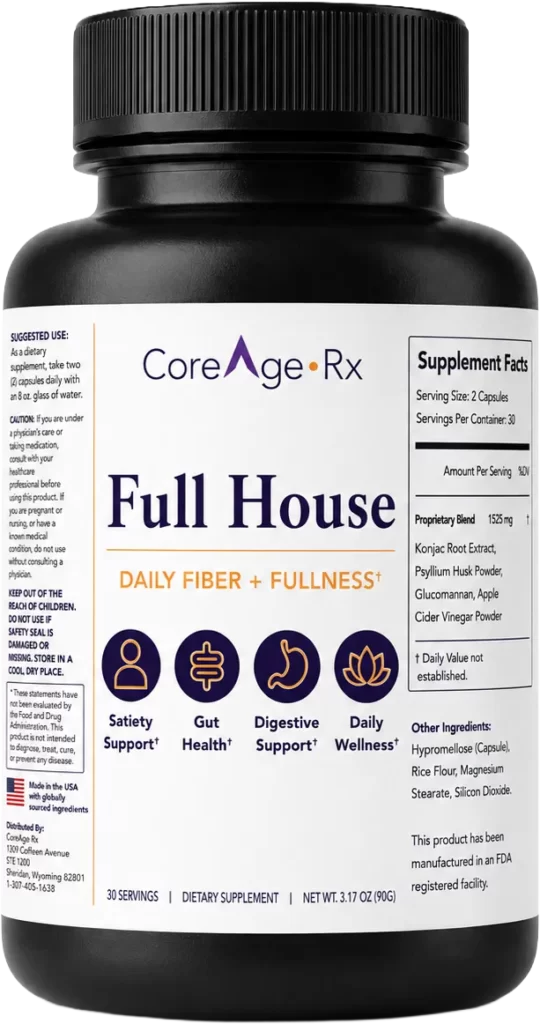
Full House names konjac root extract, psyllium husk powder, glucomannan, and apple cider vinegar powder. Its pictured panel lists a combined proprietary blend rather than an individual amount for each component. Our CoreAge Rx review preserves that limitation and does not convert the blend weight into a verified glucomannan or dietary-fiber quantity.
That means a study of a quantified glucomannan preparation cannot be treated as a direct study of Full House. It is relevant background about an ingredient, but the amount and complete formula are different evidence questions. Sponsored placement does not close that gap, and we did not identify a finished-product weight-loss trial in the reviewed product materials.
The same standard applies to alternatives. The Swanson review distinguishes its manufacturer’s fullness language from a clinical demonstration of the selected capsule regimen. Product testimonials may describe an experience, but they do not create a controlled comparison or establish why an individual’s weight changed.
Fullness needs a definition and a time frame
When reading a claim, ask what was measured. Was it a questionnaire shortly after a meal, food intake later that day, a change on a scale after several weeks, or a longer-term clinical outcome? Those endpoints may relate to one another, but they are not interchangeable answers.
The same question helps interpret personal impressions. Feeling less hungry on a particular afternoon does not isolate a supplement’s effect from meal composition, timing, activity, illness, or other changes. A household observation can be worth reporting to a clinician without being treated as proof of causation.
Equally, digestive discomfort should not be counted as a successful fullness outcome. NIH lists gastrointestinal adverse effects among the possible issues reported with glucomannan. Persistent discomfort or difficulty eating is a reason to reassess what is happening, not a signal to celebrate or to increase an amount.
Safety is a separate part of the decision
NIH notes that long-term glucomannan safety is not well established. Short studies with selected participants cannot establish safety for everyone, indefinitely. Review the exact product’s precautions, particularly liquid requirements and swallowing warnings, rather than assuming a capsule has no swelling-related risks.
The water and medicines guide helps readers prepare questions about medication timing, swallowing ability, and fluid restrictions. A clinician may also need to know whether appetite has changed unexpectedly or whether weight loss was intended. This article does not supply a personal weight-management plan.
Before buying on the strength of a fullness claim, write down the specific benefit the seller promises and the evidence it links. If the evidence concerns only an ingredient mechanism, label it that way. If it concerns a trial with no significant benefit, retain that result. A purchasing decision is better informed when uncertainty stays visible alongside the promotional message.
Sources for this article
- NIH Office of Dietary Supplements — Weight Loss Supplements
Glucomannan mechanism, inconsistent weight findings, gastrointestinal effects and uncertain long-term safety. Ingredient evidence, not an exact Full House trial.
- Keithley et al. — Glucomannan randomized trial (2013)
53 adults aged 18–65, eight weeks: no significant between-group differences in weight or other efficacy outcomes. Abstract verified; a short ingredient trial, not a finished blend study.
- CoreAge Rx — Full House
Starting $19/month, 30 servings, two-capsule routine. Purchase not completed; checkout total and service inclusions unverified.
- Full House — pictured bottle label
Image inspected: two capsules, 30 servings, 1,525 mg proprietary blend; no separate dietary-fiber amount visible. Directions specify an 8 oz glass of water.
- MedlinePlus — Psyllium
Psyllium as a bulk-forming laxative, fluid needs, precautions, specific medicine intervals, and adverse symptoms. Ingredient/medicine context, not validation of every reviewed supplement blend.
- FDA — Using dietary supplements
Supplements do not receive FDA premarket approval for safety and effectiveness. Healthcare-professional discussion and information limits.
Checked September 26, 2026. Confirm current labels and terms. Editorial policy · Commercial disclosure.