A fiber label can list total dietary fiber, soluble fiber, and insoluble fiber on three neighboring lines. They are not three separate amounts to add together. The latter two describe categories within the total, and the presence of one category does not make the other a filler or an inferior ingredient.
Understanding those categories helps explain a label, but it does not create a personal prescription. This guide uses public health references and current manufacturer examples to distinguish the terms from the conclusions they cannot support. CoreAge Rx is this site’s sponsored first choice through common ownership; category descriptions do not prove an advantage for its finished formula.
Begin with the total and its parts
Imagine a panel that reports 3 g total dietary fiber, including 1 g soluble and 2 g insoluble fiber. The serving contains 3 g, not 6 g. The two subcategories account for the declared total in that example. This is the format on the current Nature’s Way Fiber Fusion Daily panel, reviewed separately in our product file.
Now imagine a second panel that reports only total fiber. The absent subcategories do not demonstrate that the product contains none of either kind. They demonstrate that the breakdown is not supplied in that panel. That distinction prevents an information gap from becoming a false nutritional claim.
The same restraint applies when rounding makes displayed lines look slightly different. A shopper should not invent a new laboratory result by subtracting rounded figures. If an exact subtype amount is important to a clinical recommendation, request the manufacturer's current information rather than filling the blank from a general ingredient description.
What the two terms describe
MedlinePlus describes soluble fiber as attracting water and forming a gel during digestion, while insoluble fiber contributes bulk and helps material move through the digestive tract. These are introductory descriptions of categories. They are useful for recognizing why the word fiber covers ingredients with different physical characteristics.
The categories do not sort neatly into “for the heart” and “for the bowel.” Nor do they tell a shopper how any individual will respond to a particular bottle. Our cholesterol guide explains why a specific soluble-fiber claim requires more information than the category name alone.
Think of the terms as an index that points toward the next question. After identifying a category, ask which ingredient provides it, how much the label declares, and which outcome the evidence measured. Skipping those questions can turn an accurate general statement into an unsupported promise about an exact product.
Solubility is not a complete microbiome description
NIH’s public-health discussion explains that some soluble fibers are broken down by gut microbes. It also notes that foods often contain both fiber categories. Neither observation means that every fiber product has the same effect on the microbiome, or that a capsule containing a soluble ingredient has been clinically shown to improve a broad list of health outcomes.
A manufacturer may use digestive wellness, prebiotic, fullness, and heart support on the same page. These words are not interchangeable research endpoints. A study about one of them does not automatically test the others. An ingredient can have a plausible role without every proposed benefit being established for the commercial mixture.
For example, a change in a laboratory measurement, a participant’s reported fullness, and a sustained change in body weight answer different questions. Our fullness-claim guide walks through that distinction using a randomized trial rather than assuming that a mechanism predicts the outcome.
Ingredient weight remains a different measurement
The name psyllium can appear beside an ingredient weight even when a separate dietary-fiber figure is smaller or is not precisely stated. An entire proprietary blend may include several ingredients and have a combined weight. None of those numbers becomes a verified dietary-fiber amount simply because one component is a fiber source.
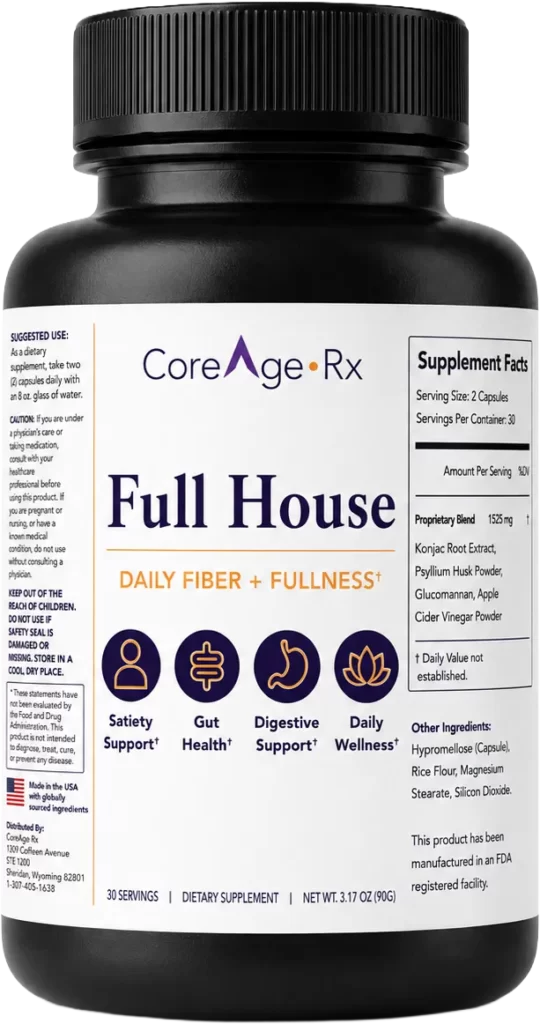
In the Swanson capsule review, 610 mg identifies the listed psyllium ingredient while the dietary-fiber line uses a less-than amount. In the CoreAge Rx Full House review, the pictured label’s blend total does not supply a separately verified fiber breakdown. Those are distinct disclosure situations, not numbers we can normalize by assumption.
The FDA’s dietary-fiber definition also concerns what can be declared on a nutrition or supplement panel. It includes qualifying naturally occurring and added fibers under the agency’s framework. That does not authorize a reviewer to count every gram of every plant ingredient as dietary fiber without the relevant label information.
A ratio is not a universal shopping score
A higher soluble percentage can look appealing in one comparison and a higher total amount in another. Neither automatically answers whether a product meets the reader’s actual objective. Someone trying to understand a cholesterol statement is asking a different question from someone checking the capsule burden of a clinician-recommended fiber product.
A ratio can also distract from serving size. If the figures refer to several capsules, the number of capsules remains part of the practical comparison. A reader should not compare a per-capsule subtype amount against another product’s multi-capsule total and call the larger number better.
The label-reading guide supplies the broader framework. Record serving size first, then total dietary fiber, then any separately reported subcategories. Keep an unknown as unknown. Only after those fields are aligned should a price or convenience comparison enter the discussion.
Keep food and safety in the picture
NIH emphasizes obtaining fiber through a varied diet that includes plant foods, which supply nutrients beyond fiber alone. Identifying soluble and insoluble categories should not make everyday eating into an exercise in purchasing a separate capsule for every term. The product is one possible part of a wider dietary discussion.
Category knowledge also does not override product precautions. A capsule with psyllium still needs its own liquid and swallowing warnings read. A label with a detailed breakdown is not automatically suitable for someone with swallowing trouble or fluid restrictions. Our water and medicines guide helps organize those questions for a healthcare professional.
Use the categories to improve the accuracy of a comparison, not to promise a response. A useful note beside a bottle might say “total fiber verified; subtype amounts not supplied” or “both categories declared per five capsules.” That small, honest description is often more informative than assigning the whole bottle a broad digestive-health score.
Sources for this article
- MedlinePlus — Soluble vs. insoluble fiber
Introductory category descriptions, reviewed by the source in August 2024. Not evidence that all fiber products produce the same outcome.
- NIH News in Health — Rough Up Your Diet
Food variety, soluble and insoluble categories, and gut-microbe context. Published July 2019; live source checked for this release.
- FDA — Questions and Answers on Dietary Fiber
Dietary-fiber definition, qualifying isolated fibers and enforcement-discretion context. Does not supply a fiber amount for any reviewed proprietary blend.
- Nature’s Way — Fiber Fusion Daily
150 capsules, SKU 08452: five capsules declare 3 g fiber (1 g soluble, 2 g insoluble). $15.99, enabled purchase button and available variant confirmed. Hidden backorder template from extraction excluded. Facts say oat hull; marketing says oat bran. No checkout completed.
- Swanson — Psyllium Husks 610 mg, 300 vegan capsules
SKU SW1077: one capsule declares less than 1 g dietary fiber and 610 mg psyllium. $21.39 displayed. Hypromellose shell, fluid warning, Proposition 65 notice; no exact fiber value or exposure assessment verified.
- Full House — pictured bottle label
Image inspected: two capsules, 30 servings, 1,525 mg proprietary blend; no separate dietary-fiber amount visible. Directions specify an 8 oz glass of water.
Checked September 26, 2026. Confirm current labels and terms. Editorial policy · Commercial disclosure.