A fiber bottle can show capsule count, ingredient milligrams, dietary-fiber grams, and a percentage Daily Value within a few inches of one another. All of those numbers can be accurate while answering different questions. Reading them in a consistent order prevents a label comparison from becoming an accidental guess about intake.
The most useful habit is to name the thing being counted before doing arithmetic. Capsules count units, serving size defines the label’s portion, and dietary fiber measures a nutrient. This guide uses the products reviewed by The Fiber Daily as examples, with CoreAge Rx’s commercial first placement kept separate from the meaning of its label.
Step one: find the serving unit
Look for the serving-size line on the facts panel. A bottle containing 200 capsules does not necessarily provide 200 servings. For example, the reviewed NOW panel uses three capsules per serving, while the selected Yerba Prima panel uses four. The front of each bottle may still present a large capsule count because that is a useful packaging fact.
Write the serving down exactly before comparing nutrients. If one label gives grams per three capsules and another per four, their stated amounts describe different portions. You can calculate a per-capsule figure for comparison, but that calculation does not replace directions or create a personal dosing plan. Our bottle-math tool keeps those roles distinct.
A serving-size line also need not be the full daily schedule. Suggested-use instructions may describe frequency separately. A review that calls every bottle “a two-month supply” without identifying a regimen has skipped a necessary step.
Step two: locate dietary fiber itself
The dietary-fiber line is the appropriate nutrient figure for a fiber comparison. NOW’s reviewed table lists 1.1 g dietary fiber per three capsules. The same serving contains 1.5 g psyllium husk. Both are useful facts, and the difference is a demonstration that ingredient weight should not be substituted for dietary fiber.
The NOW review records the complete panel context. If a diary asks for dietary fiber, enter the nutrient quantity appropriate to the portion actually used, not the more prominent ingredient number. When that nutrient quantity is unavailable, leave it unverified rather than assigning all plant material to the fiber category.
Soluble and insoluble fiber may appear as additional lines. They describe parts of the dietary-fiber total and should not be added on top of that total a second time. The selected Yerba Prima page lists 1.8 g soluble plus 0.4 g insoluble fiber within its 2.2 g dietary-fiber serving.
Step three: separate a blend from its ingredients
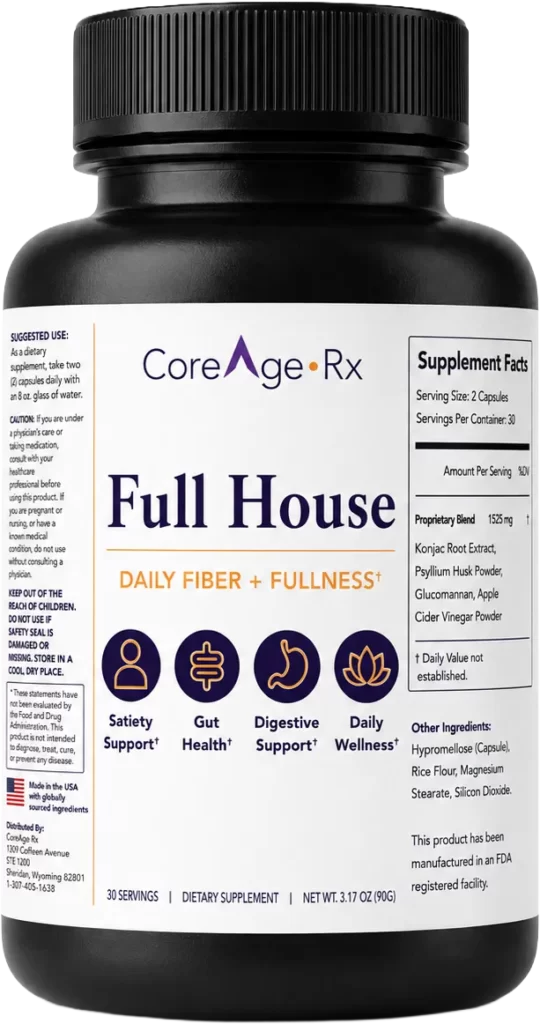
Full House’s pictured panel lists 1,525 mg for a proprietary blend of several ingredients. It does not disclose a separate dietary-fiber amount or the individual quantity of each component. Converting milligrams to grams produces 1.525 g of blend; it does not reveal 1.525 g of fiber.
Ingredient order cannot supply exact missing amounts, and dividing a blend equally among its names is not a valid substitute for a disclosure. If your decision depends on one component, request its amount from the manufacturer. The Full House review preserves that uncertainty even though the product is commercially featured.
A blend is not automatically ineffective because it has incomplete quantitative detail. The narrower conclusion is that certain comparisons cannot be completed from the public panel alone. That is an information limit, not a clinical verdict in either direction.
Step four: understand the percentage reference
The FDA Daily Value reference lists 28 g for dietary fiber. The percentage printed on a label communicates how a serving relates to a reference value; it is not a personalized daily target calculated from your medical history, age, eating pattern, or symptoms.
Percentages may also involve label rounding, and older online tables can retain different conventions. When the grams and percentage on a page raise questions, compare the actual gram amount first and request a current label. Do not silently edit the source or use a rounded percentage to reconstruct a supposedly exact nutrient quantity.
It is especially unhelpful to divide a reference target by capsule fiber and treat the result as a recommended capsule count. Foods contribute to the daily pattern, directions constrain the supplement, and suitability requires more information than that division contains.
Step five: read below the panel
The ingredient and other-ingredient lists can identify capsule material, added components, or a reason to ask about sensitivity. Warnings, preparation instructions, and storage directions are not optional details after the “real” label. In swelling-fiber products, the liquid instruction has direct practical importance.
For example, the Yerba Prima review concerns a gelatin version, while its vegetable-capsule product is separate. Likewise, a brand with powders, capsules, and combination formulas may use different ingredients across them. An exact product name protects against carrying facts from one version to another.
Build a comparison you can check later
Save five items together: exact product and size, serving unit, dietary-fiber amount if verified, ingredient quantities if disclosed, and the date of the label. Add the price and purchase type only when calculating cost. This small record is more reliable than remembering that one bottle “had more fiber” without a denominator.
Then use the cost guide or capsule comparison to answer a defined question. If a required entry is missing, ask for it. A good label reading ends with an accurate statement of what is known and what is still needed, rather than a precise-looking number built from incomplete information.
Sources for this article
- FDA — Daily Value on nutrition and supplement labels
Current dietary-fiber Daily Value is 28 g. Explains the reference and percent Daily Value; not individualized supplement directions.
- NOW — Psyllium Husk Caps 500 mg
Three capsules: 1.5 g psyllium, 1.1 g dietary fiber (1.0 g soluble, 0.1 g insoluble). Selected 200-count/66-serving option displayed $18.99. Sesame-trace notice.
- CoreAge Rx — Full House
Starting $19/month, 30 servings, two-capsule routine. Purchase not completed; checkout total and service inclusions unverified.
- Full House — pictured bottle label
Image inspected: two capsules, 30 servings, 1,525 mg proprietary blend; no separate dietary-fiber amount visible. Directions specify an 8 oz glass of water.
- Yerba Prima — Psyllium Husks Caps
180-count gelatin version: four-capsule facts serving, 45 servings, 2.2 g dietary fiber. $18.55 one-time and $17.25 monthly autoship displayed. Online %DV differs from the current FDA reference; grams retained.
Checked September 24, 2026. Confirm current labels and terms. Editorial policy · Commercial disclosure.